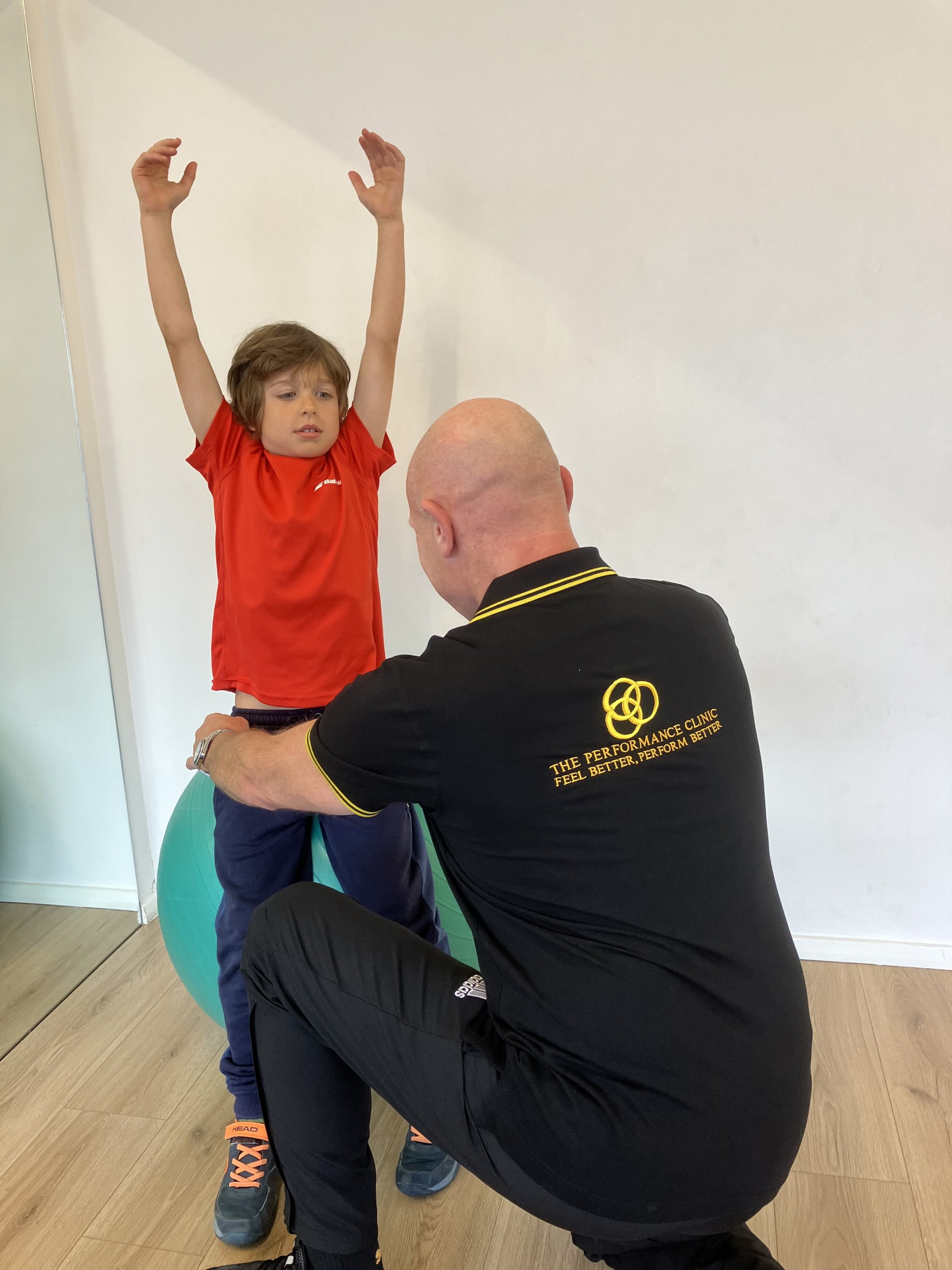
Signs to Watch For:
Parents should observe their child’s back and posture. Common signs that may indicate scoliosis include:
•One shoulder higher than the other
•Uneven shoulder blades (scapula)
•One hip higher or more prominent
•Uneven waistline
•Clothing not hanging evenly
These asymmetries may be early signs of scoliosis. If you notice them, it is recommended to consult a healthcare professional for evaluation.
Simple At-Home Check: Adam’s Forward Bend Test
This is a simple test you can do at home to detect possible spinal asymmetry.
Steps:
1.Ask your child to stand straight with feet together.
2.Have them bend forward slowly at the waist, keeping legs straight and arms hanging down.
3.Observe from behind for:
•A rib hump on one side of the back
•Asymmetry in the shoulders, hips, or waist
This test is not a diagnosis. It helps identify potential issues that should be evaluated by a doctor or physiotherapist specialist.
When to Seek Help:
Consult a healthcare professional if you notice:
•Uneven shoulders, hips, or waist
•A hump on the back during the forward bend test
•Posture changes that are new or worsening
Early detection allows for monitoring and, if necessary, early treatment to prevent progression.
BOOK with our specialists on 0191 4350560
Causes and Common Myths:
It is important for parents to understand what does and does not cause scoliosis:
•

Carrying a heavy school bag does NOT cause scoliosis
•
Poor posture does NOT cause scoliosis
•

Scoliosis is usually idiopathic, meaning the cause is unknown
•
Genetics and growth patterns may play a role, but it is not caused by daily habits (sosort.org)
Focusing on early recognition and professional evaluation is more important than worrying about posture or backpack weight.
References / Further Reading
•SOSORT – International Society on Scoliosis Orthopaedic and Rehabilitation Treatment
•Scoliosis Research Society – Parent & Family Guide